
What’s new in the North-East for Travel Influencers?
By Deepshikha Golley
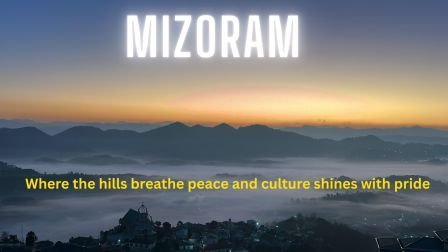
From reels to real stories, Mizoram is becoming the Northeast’s newest creative hotspot—where influencers are redefining how India sees one of its overlooked states.
Mizoram, February 16: A new destination is emerging on India’s travel influencer map. Beyond the misty waterfalls of Meghalaya, the Hornbill Festival of Nagaland, the serene Ziro Valley of Arunachal Pradesh, and the cafés and retreats of Sikkim, Mizoram’s rolling blue hills are beginning to claim space on Instagram reels and long-form travel narratives.
For decades, the state remained a faraway corner of India that few travellers reached and even fewer understood.
Now, a new generation of social media influencers is bringing Mizoram to the world’s screens—showcasing unexplored villages, a culture rooted in discipline and harmony, and a pace of life that feels increasingly rare in a world driven by speed and screens.
The shift, however, did not happen overnight. According to the Mizoram Tourism Department, the state recorded an approximate 145% jump in tourist arrivals—from 2.1 lakh in FY 2023-24 to 5.2 lakh in FY 2024-25. December 2025 alone recorded 1.3 lakh tourist arrivals, the highest monthly figure so far.
A major turning point came with the launch of the Bairabi–Sairang railway line in September 2025, directly connecting Mizoram to Delhi, Kolkata, Guwahati, and making the once-remote state significantly more accessible.
What has changed is access, perception, and a conscious effort to open up. The government, too, has turned its attention towards tourism.
The renewed focus has translated into substantial public investment. As reported by ET TravelWorld, Mizoram is currently executing projects worth ₹395.04 crore under central and externally aided schemes. These include eco-resorts, ropeways, heritage centres, pilgrimage circuits, convention infrastructure, and farm-tourism roads, under flagship programmes like Swadesh Darshan 2.0.
“This is not just about increasing tourist numbers – it is about reshaping Mizoram’s economic future through tourism,” said Lalnghinglova Hmar, Minister for Sports and Tourism, Mizoram.
In August 2025, the Tourism Department signed a two-year Memorandum of Understanding with IRCTC to develop curated itineraries, joint promotions and streamlined travel logistics. In parallel, the Restricted and Protected Area Permit system is being digitised, easing travel for both domestic and foreign visitors.
Projects such as the ‘Peace City’ development in Thenzawl further reflect the state’s attempt to blend tourism growth with urban renewal, while initiatives like the Best Tourism Village and Tour Itinerary Competitions are encouraging districts and communities to design distinctive travel experiences.
Mizoram Tourism has rolled out the Events and Festival Calendar 2026, enabling travellers to plan their visits in advance.
Beyond policies and projects, something more organic is unfolding — a revival of cultural storytelling led by travel influencers.
These creators are not outsiders parachuting in for content; they are locals reclaiming the narrative of their home. One such creator, Angela Roy (@angiemasala), a Mizoram-based brand developer and business consultant, says “India is vast and incredible, but the Northeast has always been underrepresented. Even within this region, Shillong or Nagaland often get more attention. Mizoram remained untapped — exotic and different — and that’s what draws people in now.”
Angela has watched this transformation unfold in real time. “Connectivity has changed everything,” she says. “Earlier, the cost and effort of coming here kept people away. Most mainstream and OTT destinations have already been covered and travellers want new experiences — something beyond the usual ‘mainstream’ spots. Mizoram gives them that.”
Her observation mirrors what the government data suggests: curiosity steadily turning into footfall.
Yet, many Mizos remain unsure what this new visibility will bring. Mizoram’s society is known for its discipline, quietness, and strong sense of order. “People here are very reserved,” Angela adds. Cleanliness and calm are deeply valued. While millennials, Gen Z and Gen Alpha are largely welcoming and excited, the older generation remains more sceptical—wondering how outsiders will treat their land.
Still, optimism prevails. Increased tourism brings new businesses, revenue streams and employment opportunities—especially for the youth.
And the youth is responding. Locals are converting homes into stays, turning scenic balconies into Airbnb listings, and showcasing Mizo hospitality to a curious audience online. “Homestays are booming,” Angela says. “Creators want authentic, aesthetic backdrops. I’ve guided many travellers to local homes myself, and now I see families transforming their spaces into small businesses.”
The rise of tourism, however, raises critical questions. Can Mizoram’s fragile ecosystem sustain a growing influx of travellers? Is the state prepared for mass tourism? And can development be balanced with preservation?
These concerns are increasingly being acknowledged by both policymakers and creators. Travel influencers, including Surita Chakma, are consciously promoting slow and sustainable travel—encouraging visitors to stay longer, respect local customs and support community-run homestays.
That, Angela emphasises, is the core message:
“If you are coming to Mizoram, come with the right heart.”








Leave a Reply