
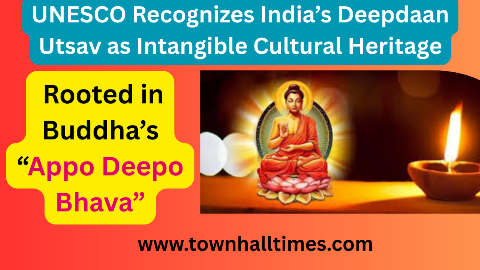
UNESCO Recognizes India’s Deepdaan Utsav as Intangible Cultural Heritage: Rooted in Buddha’s “Appo Deepo Bhava”
New Delhi, 10 December 2025 – In a historic decision, the United Nations Educational, Scientific and Cultural Organization (UNESCO) today inscribed India’s Deepdaan Utsav – the festival of offering lamps, popularly known as Diwali – on the Representative List of the Intangible Cultural Heritage of Humanity. The announcement was made during the 20th session of the Intergovernmental Committee meeting at the iconic Red Fort in Delhi.
UNESCO’s official citation highlights the festival’s deep connection with Lord Buddha’s teachings, particularly the profound Pali phrase “Appo Deepo Bhava” (“Be your own lamp” or “Be a light unto yourself”), which the Buddha delivered to his disciples during his final days. The organization specifically recognized the centuries-old Indian tradition of people making their own earthen lamps by hand as a living embodiment of this Buddhist principle of self-reliance, inner illumination, and victory of knowledge over ignorance.The UNESCO statement reads in part:
“The Deepdaan Utsav, celebrated across India and by Indian diaspora worldwide, is a vibrant festival of light that marks the end of the harvest season and the beginning of a new cycle. Centred on the act of lighting and offering lamps, it symbolizes the triumph of light over darkness and good over evil.
Families and communities clean and decorate their homes, craft earthen lamps with their own hands, fill them with ghee or oil, and illuminate streets and sacred spaces. This practice of personally shaping and offering lamps reflects the ancient Buddhist teaching ‘Appo Deepo Bhava’, encouraging individuals to become their own source of wisdom and enlightenment.”According to cultural historians, the tradition traces back over 2,500 years. When Gautama Buddha returned to Kapilavastu after attaining enlightenment, citizens welcomed him by lighting thousands of lamps – an event that became the first recorded Deepdaan Utsav. Later, on the eve of his Mahaparinirvana, the Buddha urged his followers with the words “Appo Deepo Bhava”, making the act of creating and lighting one’s own lamp a powerful metaphor for spiritual autonomy.
In modern India, millions still follow the ritual of moulding clay lamps on the potter’s wheel or by hand, painting them with natural colours, and lighting them during Diwali. This eco-friendly practice stands in sharp contrast to mass-produced plastic or chemical-based lights and has been praised by environmentalists for reducing pollution.
Prime Minister Narendra Modi welcomed the decision, stating, “Diwali is the soul of Indian civilization – a festival of light, faith, and unity. UNESCO’s recognition of Deepdaan Utsav, inspired by Lord Buddha’s eternal message ‘Appo Deepo Bhava’, is a moment of pride for 1.4 billion Indians and the global Buddhist community.”With this inscription, Deepdaan Utsav becomes India’s 16th element on UNESCO’s Intangible Cultural Heritage list, joining Yoga, Kumbh Mela, Durga Puja, Garba, and others.Tonight, the Red Fort, India Gate, Qutub Minar, and dozens of UNESCO World Heritage sites across the country were illuminated with lakhs of hand-crafted earthen lamps in a grand celebration. Artisans, monks, and families from Buddhist, Hindu, Jain, and Sikh communities participated together, reaffirming that the festival of light belongs to humanity’s shared heritage.As the world adopts Diwali celebrations in Times Square, Trafalgar Square, and beyond, UNESCO’s recognition ensures that the ancient call – “Be a light unto yourself” – will continue to glow for generations to come.








Leave a Reply