
Townhall Times, New Delhi
Reporter: Bhavika Kalra
By: Strategic Space Bureau | Chitradurga/Bengaluru
Tuesday, February 24, 2026
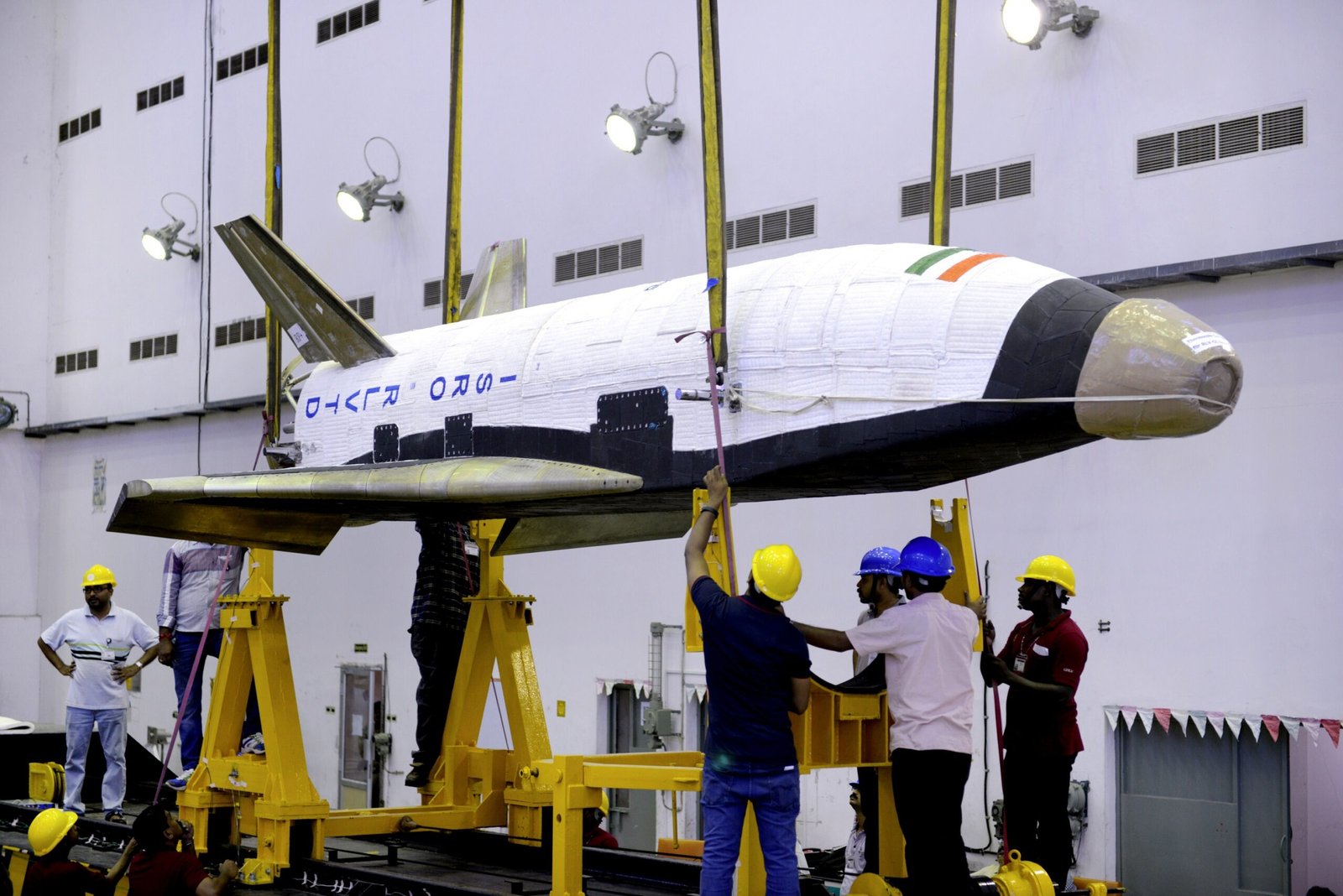
The era of “throwaway rockets” is officially on its deathbed in India. This week, ISRO’s Pushpak—the winged prototype of the Reusable Launch Vehicle (RLV)—completed its most aggressive landing test yet at the Aeronautical Test Range (ATR) in Chitradurga.
If you think this is just a repeat of the 2024 tests, you’re missing the fine print. This latest mission was about simulating a return from orbit, not just a drop from a helicopter.
1. The ‘Chinook’ Drop & The Mach-Speed Correction
The test began at 7:10 AM when an Indian Air Force Chinook helicopter hauled Pushpak to an altitude of 4.5 km.
-
The “Off-Nominal” Challenge: This wasn’t a straight drop. The vehicle was released at a deliberate offset—essentially “out of position.”
-
Autonomous Survival: Within milliseconds, Pushpak’s onboard guidance system (developed by VSSC) took over. It didn’t just fall; it flew. It executed cross-range and down-range corrections to align itself with the runway centerline without a single human touch.
-
The High-Speed Flare: It touched down at a blistering 320 km/h—significantly faster than a commercial jet (260 km/h) or even a fighter aircraft (280 km/h).
2. Why ‘Pushpak’ is the ‘Swadeshi Space Shuttle’
ISRO Chairman V. Narayanan (who took the helm recently) has made it clear: if we want to build the Bharatiya Antariksh Station (BAS) by 2035, we can’t afford to keep building new rockets for every brick.
-
Cost Efficiency: A reusable first stage could slash launch costs by up to 60%.
-
Multisensor Fusion: The vehicle used a high-tech cocktail of NavIC, Radar Altimeters, and Pseudolite systems to “see” the runway through atmospheric turbulence.
-
The Brake Chute: To stop a winged body moving at 320 km/h on a limited runway, Pushpak deployed its specialized brake parachute and nose-wheel steering, coming to a dead stop within the designated safety zone.
3. The Larger 2026 Roadmap: 18 Missions Lined Up
This RLV test is just one piece of a frantic 2026 calendar. Despite recent setbacks with a PSLV anomaly in January, ISRO is pushing for a record 18 orbital missions this year.
-
Gaganyaan Update: Just last Thursday (Feb 19), ISRO and DRDO successfully tested the Drogue Parachutes in Chandigarh. These are the “lifesavers” that will stabilize the crew module when Indian astronauts return from space.
-
The Docking Mission: ISRO is currently preparing for an uncrewed docking demonstration with the International Space Station (ISS)—a critical test to prove we can “park” a spacecraft in orbit.
4. Comparative Analysis: India vs. The World
| Feature | SpaceX Falcon 9 | ISRO Pushpak (RLV) |
| Recovery Mode | Vertical Landing (Booster) | Horizontal Landing (Winged) |
| Reuse Philosophy | Engine-heavy return | Aerodynamic gliding |
| Mission Goal | Commercial Mass Delivery | Orbital Re-entry & Debris Management |
The Verdict: The ‘ORV’ is Next
With the “Landing Experiments” (LEX) now considered a “hat-trick” success, ISRO is moving to the big leagues: the Orbital Re-entry Vehicle (ORV). The next version of Pushpak will be 1.6 times larger and will be launched into a 400 km orbit by a modified GSLV, designed to survive the brutal heat of atmospheric re-entry.






Leave a Reply