
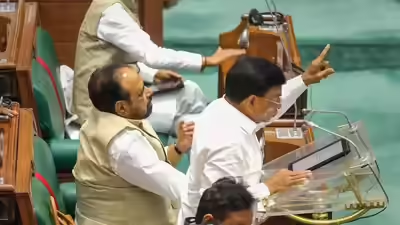
Townhall Times, New Delhi
Reporter: Bhavika Kalra
Today in Bhopal, Finance Minister Jagdish Devda didn’t just present a budget; he presented a survival and growth manual for rural Madhya Pradesh. By declaring 2026 the “Year of Agriculture” (Kisan Kalyan Varsh), the state is making it clear where its heart—and its money—is.
While the total budget size has crossed ₹4.38 lakh crore, the real story is in the ₹5,500 crore earmarked for the CM Krishak Unnati Yojana (Chief Minister’s Farmer Prosperity Scheme).
1. The ₹5,500 Crore Question
The headline-grabbing allocation for the CM Krishak Unnati Yojana is about more than just cash transfers.
-
The Goal: It’s designed to provide an extra layer of income security for the 40 lakh registered farmers in the state.
-
The “Top-up”: Combined with the PM Kisan Samman Nidhi, many farmer families are now looking at a guaranteed ₹12,000 annually directly in their accounts. In a state where wheat and soybean prices fluctuate wildly, this is the “emergency fund” every small farmer needs.
2. Going Solar: 1 Lakh Pumps
The budget has put aside ₹3,000 crore specifically to give out 1 lakh solar pumps.
-
Why it matters: For a farmer in the Malwa or Bundelkhand region, electricity is the biggest headache. Power cuts during the peak irrigation season can ruin a whole crop.
-
The Shift: By moving to solar, the state is trying to decouple farming from the shaky power grid. It’s a one-time investment that saves the farmer from monthly bills and the government from massive power subsidies.
3. The “White Revolution” 2.0
There is a massive push to turn MP into India’s “Milk Capital.”
-
The Target: The state wants to jump from 9% to 20% of India’s total milk production.
-
The Incentive: Milk procurement prices are being hiked, and the budget supports the Dr. B.R. Ambedkar Kamdhenu Yojana to build 1,200 new milk cooperatives. They are treating buffaloes and cows like “parallel income engines” so that a farmer isn’t purely dependent on the harvest.
4. Safety Nets: Insurance and Interest
Farming is essentially a gamble with the weather. To hedge that bet, the budget includes:
-
₹1,299 Crore for Fasal Bima: This is the premium support for the PM Crop Insurance scheme. It ensures that if the monsoon fails (or rains too much), the farmer doesn’t end up in a debt trap.
-
₹720 Crore for Interest-Free Loans: The government is subsidizing the interest on short-term crop loans so that farmers can buy seeds and fertilizers without going to local moneylenders.
5. The Ken-Betwa Lifeline
Infrastructure got a big nod with ₹1,000 crore set aside for the Ken-Betwa Link Project.
-
The Impact: This is the “holy grail” for the drought-prone Bundelkhand region. It’s expected to eventually irrigate over 8.8 lakh hectares of land. For thousands of villages, this is the difference between farming twice a year and migrating to the city for labor.
The Reality Check (Feb 18, 2026)
The Finance Minister noted that the state’s agriculture budget has grown from a measly ₹600 crore in 2003 to over ₹27,000 crore today. The strategy for 2026 is simple: Diversify. They want farmers to move into horticulture, natural farming (targeted at 1 lakh hectares), and dairy so that one bad harvest doesn’t wipe out a family.









Leave a Reply