
The contemporary discourse on New educational reform in India particularly the call by Narendra Modi to transcend a residual “colonial mentality” must be situated within a broader inquiry into the epistemological, institutional and affective foundations of the modern educational apparatus. The rhetoric of decolonization, while ostensibly concerned with curricular content and civilizational self-assertion, also invites a more penetrating interrogation of the normative architecture that governs subject formation within competitive pedagogical regimes. Recent episodes of extreme intra-familial violence involving high-performing students in Lucknow and Sidhi render this interrogation not merely theoretical but urgently empirical. When individuals emblematic of scholastic distinction and meritocratic promise become agents of catastrophic rupture, the explanatory framework must exceed criminological particularity and engage structural causality.
The Indian civilizational ethos, frequently encapsulated in the maxim sa vidyā yā vimuktaye (knowledge as emancipation), presupposes an integral conception of education as ethical cultivation and ontological refinement. However, the contemporary educational order appears increasingly aligned with a performative rationality that privileges quantification, comparability, and instrumental efficacy over interior development. The disjunction between normative ideal and institutional praxis necessitates a conceptual vocabulary capable of apprehending systemic affective depletion what may be designated as affective insolvency.
A purely psychological account of violent aberration proves analytically insufficient. As Émile Durkheim demonstrated in his sociology of moral regulation, individual pathologies often crystallize collective disturbances. His formulation of anomie—a state of normative deregulation arising from rapid socio-economic transformation illuminates the destabilizing consequences of aspirational inflation coupled with regulatory attenuation. In hyper-competitive educational ecologies, where symbolic rewards are scarce and expectations are incessantly amplified, the subject confronts an existential incongruity between culturally prescribed success and structurally constrained attainment. This incongruity generates not merely frustration but ontological insecurity.
The neoliberalization of education intensifies this predicament. Academic performance has been transfigured into a fungible asset within a marketized social order. Credential accumulation functions as a mechanism of stratification, while standardized testing, coaching industries, and ranking algorithms constitute a disciplinary infrastructure that reconfigures learning into perpetual audit. Here, Michel Foucault’s analysis in Discipline and Punish acquires renewed pertinence. The examination operates as a technology of surveillance and normalization, producing subjects who internalize evaluative gazes. Through processes of quantification and classification, identity itself becomes numerically mediated. The student emerges as a calculable entity, intelligible primarily through metrics of performance. In such a regime, failure is not episodic but ontological; it threatens the very coherence of the self.
Moreover, even those who achieve institutional success are ensnared within what may be termed anticipatory precariousness, the anxiety of potential displacement in a vertically stratified meritocracy. The relentless imperative of self-optimization engenders a regime of auto-exploitation. Byung-Chul Han’s reflections in The Burnout Society underscore the paradox of late modern subjectivity: domination no longer appears as external coercion but as self-imposed productivity. The achievement-subject becomes both sovereign and subordinate, simultaneously author and victim of his own exhaustion.
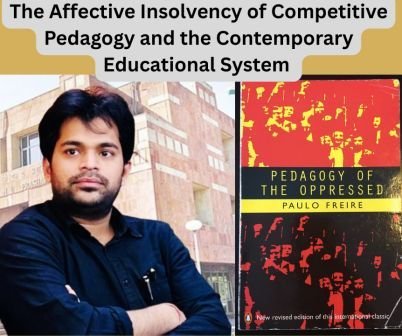
The affective consequences of such a system can further be theorized through Erich Fromm’s distinction between modes of “having” and “being,” elaborated in The Sane Society. When identity is predicated upon possession of grades, ranks, and certifications the self is alienated from experiential authenticity. Education, under the hegemony of acquisitive rationality, risks degenerating into a credentialist enterprise rather than a transformative encounter. Similarly, Paulo Freire’s critique in Pedagogy of the Oppressed of the “banking model” remains instructive: pedagogical arrangements that reduce learners to repositories of information foreclose dialogical agency and critical consciousness. Even in ostensibly dynamic and competitive environments, the instrumentalist fixation on measurable output may inhibit reflexive subjectivity.
The family, traditionally idealized as an affective sanctuary, is not immune from these structural transformations. Pierre Bourdieu conceptualizes the family as a locus for the transmission of cultural capital and habitus reproduction. In contexts of intensified credential competition, familial relationships may become inadvertently recalibrated through evaluative metrics. Parental aspiration, mediated by social comparison, risks mutating into performative surveillance. The language of affection becomes interwoven with the lexicon of achievement, thereby altering the phenomenology of intimacy.
The condition described herein as affective insolvency does not denote the extinction of emotion but rather its institutional marginalization. Educational policy architectures prioritize infrastructural expansion and curricular reform while relegating emotional resilience to ancillary status. Counseling services remain underdeveloped; stigma surrounding mental health persists; educators are encumbered by administrative accretions that constrain pastoral engagement. The result is a culture of privatized suffering wherein vulnerability is disavowed and distress is internalized.
Normative alternatives exist within both indigenous and global pedagogical traditions. Rabindranath Tagore articulated a vision of education as holistic cultivation integrating intellectual inquiry, aesthetic sensibility, and ethical refinement. John Dewey advanced an experiential and democratic conception of learning, wherein education functions as the formative ground of participatory citizenship rather than mere economic utility. These frameworks resist the reduction of pedagogy to competitive credentialism.
A comprehensive response must therefore be multi-layered. The decolonial aspiration articulated by Narendra Modi, if extended beyond symbolic rhetoric, could encompass an epistemic recalibration that foregrounds moral and affective dimensions of learning. At the societal level, initiatives such as the Panch Parivartan program of the Rashtriya Swayamsevak Sangh, articulated by Mohan Bhagwat through the concept of Kutumb Prabodhan, emphasize dialogical renewal within the familial sphere. Institutionally, however, more structural interventions are requisite: the integration of mental health infrastructures into core educational governance; the embedding of emotional literacy and ethical deliberation within teacher formation; and the diversification of evaluative criteria beyond narrow performance metrics.
The recurrent tragedies in Lucknow and Sidhi must thus be apprehended not as anomalous eruptions but as symptomatic disclosures of a deeper systemic contradiction. When excellence is severed from empathy and ambition from moral anchorage, the pedagogical order risks generating technically proficient yet affectively impoverished subjects. The normalization of competitive pressure does not neutralize its corrosive potency; ubiquity does not confer legitimacy. If education is to preserve its emancipatory vocation, it must undergo an axiological reconstitution that restores the primacy of ethical formation and emotional equilibrium. Absent such recalibration, the
contemporary educational order will continue to produce measurable success while silently eroding the conditions of humane coexistence.
Amit Kumar Yadav
Research Scholar in Political Science
Jawaharlal Nehru University, New Delhi
And National President of Indian Academic Forum for Social Justice











Leave a Reply