
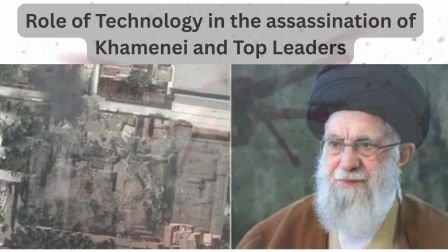
Role of Technology in the Assassination of Khamenei and Top Leaders
Anthropic and AI: Claude Model, Targeting, Simulation, and the Speed of the “Kill Chain”
At the end of February 2026, events in Iran shook the world. On February 28, a reported joint U.S.–Israeli military operation allegedly killed Iran’s Supreme Leader Ali Khamenei, along with several senior military and security officials. According to emerging accounts, this was not a sudden decision but the result of months of planning and intelligence preparation.
Reports suggested that the operation began by targeting a high-level meeting where top leadership figures were present. The Central Intelligence Agency had allegedly monitored movements, routines, communication patterns, and possible locations over an extended period. This intelligence was reportedly shared with Israeli counterparts. Cyber technologies were then used to confirm real-time locations before a precision missile strike was carried out.
The key question now is: what role did technology and artificial intelligence play?
According to various reports, the U.S. military relied on advanced AI tools for large-scale data analysis, pattern recognition, target prioritization, and battlefield simulations. Particular attention has been drawn to systems developed by Anthropic, especially its “Claude” model, which was reportedly used to process satellite imagery, drone footage, and signals intelligence at extraordinary speed. Instead of human analysts spending hours reviewing information, AI systems could scan and interpret vast datasets in seconds.
This significantly accelerated what military strategists call the “kill chain” — the process from identifying a target to executing a strike. By shortening the time between detection and action, AI-driven systems can increase operational speed and coordination.
Interestingly, the company involved has previously faced political and ethical debates regarding the use of AI in military contexts. However, once advanced technologies become integrated into defense systems, removing them entirely is rarely straightforward. On the battlefield, decision-makers often rely on tools that promise speed, efficiency, and precision.
How AI Is Changing Warfare
-
Speed: Decisions that once took hours can now be supported within seconds.
-
Precision: Machine learning systems can detect patterns in massive datasets more effectively than traditional methods.
-
Scale: Multiple targets can be monitored and coordinated simultaneously.
-
Reduced Reaction Time: The gap between identification and strike becomes dramatically shorter.
However, the story does not end there. While AI may not physically press the final button, its growing role in shaping decisions raises critical ethical and strategic concerns. Faster wars can also become deadlier. The risks of civilian casualties, misidentification, or flawed algorithmic assessments remain significant.
In simple terms, modern conflicts are no longer fought solely with weapons — they are also fought with algorithms. Technology is no longer operating in the background; it has moved to center stage. This is not science fiction. It represents a new reality in which the nature of warfare is rapidly evolving, and artificial intelligence increasingly influences its pace and direction.









Leave a Reply