
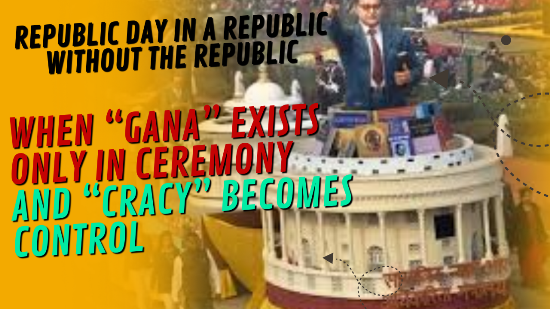
Republic Day in a Republic Without the Republic
When “Gana” Exists Only in Ceremony and “Cracy” Becomes Control
By Townhall Times | Republic Day Special Analysis
Every 26 January, India celebrates itself as a sovereign, socialist, secular, democratic republic. Tanks roll down Rajpath, fighter jets paint the sky, and the Constitution is invoked in rehearsed speeches. Yet beyond the parade route, a disturbing contradiction defines the Republic of India today: the people (“Gana”) are increasingly absent from power, while “cracy” — rule by an unaccountable elite — has entrenched itself in the name of democracy.
Republic Day has become less a reminder of constitutional morality and more a ritual masking the systematic hollowing out of democratic institutions.
Democracy Without Dissent
At the heart of any republic lies the freedom to dissent. Today, that freedom is under unprecedented strain.
India’s prisons are filled not with convicts but with undertrials — nearly 75–78% of the prison population, according to official prison statistics. Among them are scholars, journalists, social workers, student leaders, lawyers, and human rights defenders, many incarcerated under stringent laws like UAPA, where bail is the exception and trial itself becomes punishment.
Cases drag on for years. The message is unmistakable: disagreement with power is criminalised, while loyalty is rewarded.
Judiciary Under Pressure: The Illusion of Independence
The judiciary is constitutionally meant to act as the final shield between the citizen and the state. But even this pillar shows visible fractures.
One of the most telling examples remains the transfer of Justice S. Muralidhar in February 2020. As a sitting judge of the Delhi High Court, Justice Muralidhar ordered urgent police action against politicians accused of delivering hate speeches during the Delhi riots. Within hours of his late-night hearing, his transfer to the Punjab and Haryana High Court—already cleared but suddenly executed—was notified.
While officially termed “routine”, the timing sent a chilling signal across the judiciary: judicial assertiveness against the executive carries consequences.
Similarly, senior judges like Justice Akil Kureshi, who ruled against powerful political interests, saw long delays and resistance in elevation. These are not isolated incidents but patterns that erode public confidence in judicial independence.
Justice delayed is injustice. Justice transferred is intimidation.
Institutions Captured, Not Strengthened
Beyond the judiciary, institutional autonomy has weakened across the board:
-
Investigative agencies are increasingly perceived as selective, acting swiftly against opposition figures while remaining inactive in cases involving ruling-party allies.
-
Parliamentary debate has collapsed, with major laws passed without adequate discussion.
-
Media, once the fourth pillar, now functions largely as a megaphone for official narratives, marginalising critical voices and manufacturing consent.
India ranks 161 out of 180 countries in global press freedom indices — a position incompatible with any genuine democracy.
Saints Humiliated, Critics Silenced
A republic that claims moral and spiritual depth now routinely parades humiliation as governance. Religious figures, monks, and social reformers who criticise power structures face public vilification, raids, arrests, or prolonged harassment.
This selective reverence — worshipping compliant spirituality while punishing ethical dissent — reflects not civilisational confidence but political insecurity.
Economic Reality vs Manufactured Growth
Official narratives celebrate India as the “world’s fastest-growing major economy.” Yet growth figures collapse under scrutiny.
-
Unemployment, especially among youth aged 20–29, remains alarmingly high, hovering around 40–45% by several independent estimates.
-
Real wages have stagnated, while informal employment has expanded.
-
Public spending on health remains around 2% of GDP, far below global averages, resulting in overburdened hospitals and catastrophic out-of-pocket expenses for citizens.
-
Government schools are shutting down or being merged, particularly in rural and marginalised regions, even as access to quality education becomes increasingly privatised.
Meanwhile, the Indian rupee has steadily depreciated, moving from roughly ₹68 per USD in 2018 to nearly ₹90 per USD, eroding purchasing power and exposing structural weaknesses masked by headline GDP numbers.
This is not inclusive growth. It is statistical growth divorced from lived reality.
Media as Performance, Not Scrutiny
Television studios have replaced investigative journalism with nightly spectacles. Fake optimism is curated, dissenting data is dismissed as “anti-national,” and suffering is reframed as sacrifice for a greater cause.
The result is a dangerous illusion: a nation told it is thriving while citizens struggle to survive.
Republic Day as a Moral Audit
Republic Day was never meant to be a festival of obedience. It was meant to be a moral audit of power.
Dr. B.R. Ambedkar warned that political democracy cannot survive without social and economic democracy. Today, both are eroding. Institutions remain standing, but their spirit is compromised. Elections exist, but accountability weakens. Courts function, but fear shadows independence.
A republic does not die in one moment. It decays gradually — through silence, compliance, and ritualised celebration.
Conclusion: Beyond the Parade
If Republic Day is to mean anything beyond pageantry, it must provoke uncomfortable questions:
-
Who truly governs in the name of the people?
-
Why are critics in jail while institutions fall silent?
-
Why does growth not translate into dignity?
-
And why does the Constitution appear powerful only in speeches, not in the streets?
Until these questions are confronted honestly, India will remain a republic in form, but not in substance.
The tricolour still flies high.
The Constitution still exists.
But the Republic — the people’s republic — is waiting to be reclaimed.






Leave a Reply