
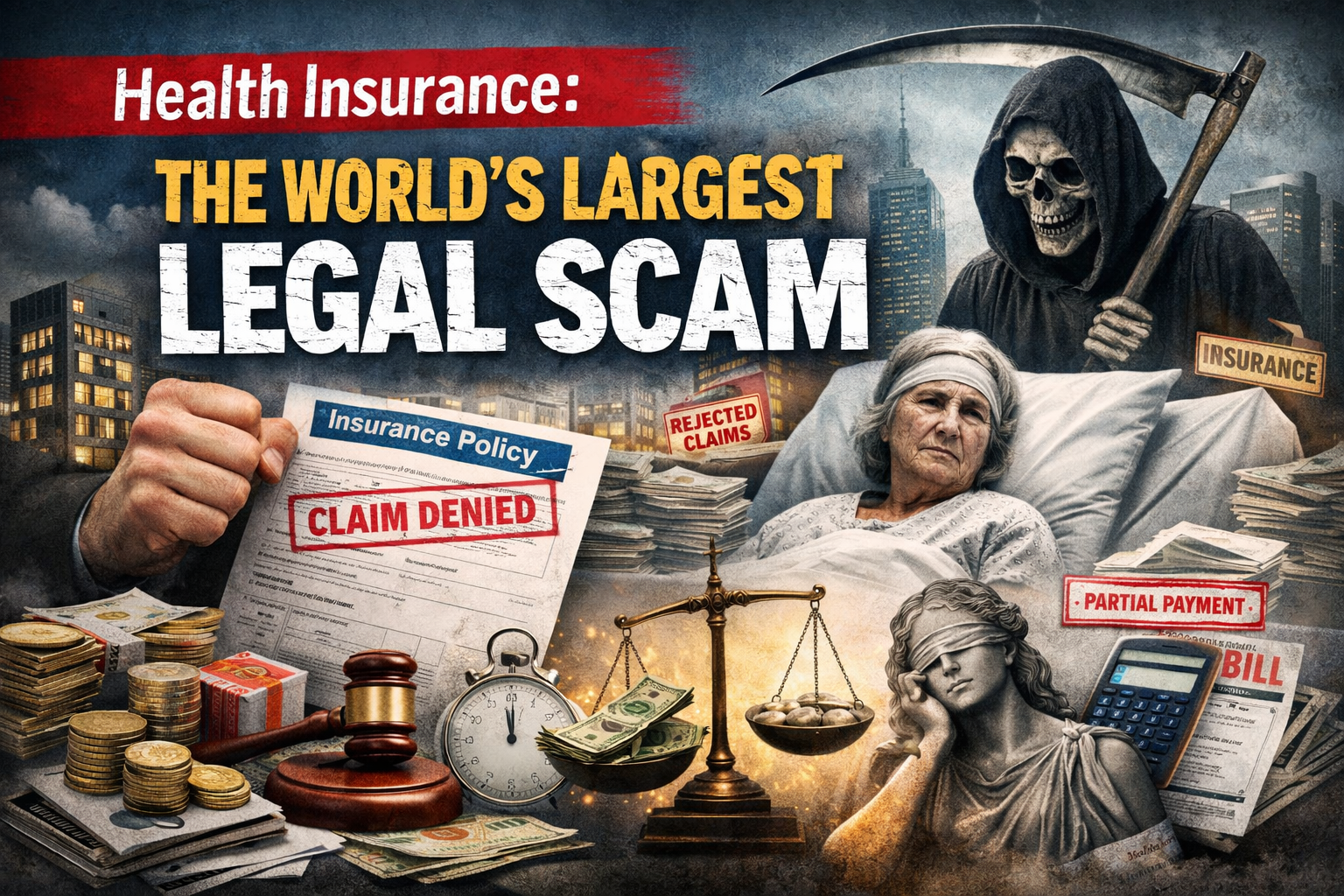
Health insurance: The World’s Largest Legal Scam
The Fraud in Claim Settlement—Inflated Numbers, Partial Payouts, and Eroding Trust
Justice Delayed in the Name of Justice—The Inactive and Biased Role of Consumer Forums and the Ombudsman
Townhall Times | Special Report
In any country, the unchecked expansion of insurance companies is often a sign that the government and social system have failed in their most basic responsibilities. When a fundamental necessity like healthcare cannot be provided directly, affordably, and with quality, the promise of a “welfare state” is reduced to empty rhetoric. In India, schemes such as Ayushman Bharat may create the illusion of relief, but the reality is that ordinary citizens still remain at the mercy of private hospitals and insurance corporations.
Today, health insurance in India has become an industry worth ₹1.1–1.2 lakh crore annually, growing at a rate of 18–20 percent every year. The question is: at what cost is this massive business being built? The answer is simple—on incomplete treatment and partially paid claims of ordinary people.
According to IRDAI data, approximately 3.2–3.3 crore health insurance claims are filed each year. Companies claim that 82–90 percent of these are “settled.” But this is where the biggest deception lies. “Settlement” does not mean full payment. If a claim of ₹10 lakh results in only ₹6 lakh being paid, it is still recorded as “settled.” Through deductions for room rent limits, consumables, non-medical items, and registration charges, 20–30 percent of the amount is routinely cut.
In FY24 alone, around 8–11 percent of claims were outright rejected, amounting to nearly ₹26,000 crore—about 19 percent higher than the previous year. The deeper truth is even more troubling: the rate of deductions and rejections is far higher in large, serious medical cases, while smaller claims are easily approved to artificially inflate the Claim Settlement Ratio (CSR).
Some insurers boast CSR figures of 95–99 percent, but they never disclose what percentage of the actual claim amount is paid. CSR only reflects the “number of claims,” not the “value of claims.” This is the greatest sleight of hand in the entire system. It is why companies facing thousands of complaints can still advertise themselves as “the most trustworthy.”
When aggrieved consumers turn to consumer forums or the insurance ombudsman, they encounter yet another wall—years of delay. Millions of cases remain pending. In practice, an unwritten understanding seems to exist between consumer courts, ombudsmen, and insurance companies: drag the case out until the consumer is exhausted and the company is relieved of responsibility.
The government’s role is also under serious question. Despite being fully regulated, insurance companies operate with impunity because they are deeply embedded in the economic and political ecosystem. Allegations of corporate–government collusion and electoral funding only deepen public distrust.
The conclusion is unmistakable: unless the government enforces strict control over insurers, mandates transparency based on the amount paid rather than the number of claims, and ensures swift justice, health insurance will remain not a shield for citizens but a system of organized exploitation. The real solution lies not in promoting insurance, but in building a strong public healthcare system—where treatment is a right, not a transaction.
#HealthInsuranceScam
#LegalScam
#InsuranceExposed
#TheInsuranceLie
#ClaimDenied
#JusticeForPatients
#ConsumerRights
#HealthcareAccountability
#EndInsuranceExploitation
#PatientsBeforeProfits










Leave a Reply