
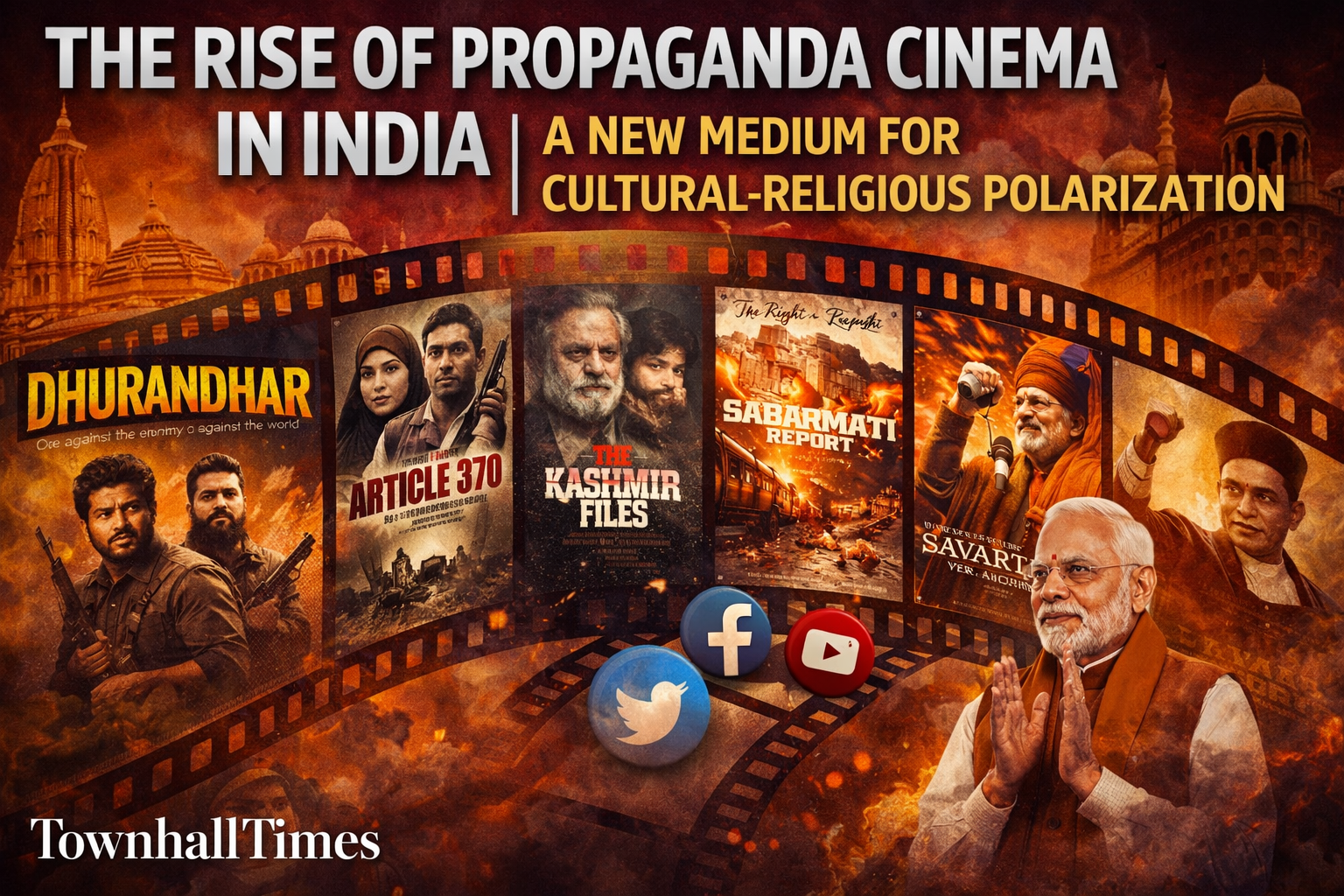
The Rise of Propaganda Cinema in India: A New Medium for Cultural-Religious Polarization
An Academic Analysis | Townhall Times
Introduction
Cinema has long been understood as a mirror of society—capturing its tensions, aspirations, and contradictions. In recent years, however, a noticeable shift has emerged within sections of mainstream Indian filmmaking. Rather than merely reflecting reality, certain films increasingly appear to shape and construct political, cultural, and religious narratives. This transformation has positioned cinema as an influential tool in public opinion formation, identity politics, and social polarization. This article critically examines these developments, particularly focusing on films that have gained prominence since 2014 and are often described by scholars as forms of “propaganda cinema.”
- Understanding Propaganda Cinema: A Theoretical Lens
In media and political communication studies, propaganda refers to the strategic dissemination of information aimed at promoting a particular ideology, identity, or power structure. It typically relies on selective facts, emotional storytelling, and symbolic narratives to influence perception. Complex realities are often simplified, crises may be amplified, and opposing viewpoints are portrayed negatively.
Within the Indian context, such cinema often demonstrates three recurring characteristics:
- The construction of a perceived religious or cultural threat.
- The glorification of state power or political leadership.
- The portrayal of opposing communities or ideologies as adversarial or dangerous.
Together, these elements create a polarized framework of “us versus them,” shaping audience perception through emotional and ideological alignment.
- Case Study – The Kerala Story
One of the most debated examples in this category is The Kerala Story, which has attracted both commercial success and critical scrutiny.
2.1 Stated Narrative Objective
The film’s promotional messaging centered on themes such as:
- Protecting women from alleged extremist networks.
- Presenting “Love Jihad” as an organized phenomenon.
- Depicting Kerala as a hotspot of radical activity.
These themes collectively construct a narrative of cultural vulnerability and urgency.
2.2 Core Claims and Narrative Elements
The film employs several contested assertions:
- Disputed Figures: Early versions referenced thousands of women allegedly recruited into extremist groups, a claim later revised following legal and factual challenges.
- Communal Framing: Certain characters are depicted as part of coordinated efforts of coercion and conversion, reinforcing a narrative of organized threat.
- Regional Portrayal: Kerala is shown as a space deeply affected by radicalization, despite the absence of evidence supporting such a large-scale depiction.
These narrative choices have been widely debated for their factual grounding and broader social implications.
2.3 Political Reception and Impact
The film received public endorsement from Narendra Modi during an election campaign, and several states granted it tax exemptions. This institutional support contributed significantly to its commercial reach and visibility.
- Other Notable Films and Narrative Patterns
(A) The Kashmir Files
Marketed as a portrayal of historical suffering, the film frames events in stark communal binaries. Its narrative emphasizes victimhood and assigns collective responsibility, often simplifying a complex historical conflict into a singular perspective.
(B) Article 370
This film presents the abrogation of Article 370 as a decisive national achievement. Through strong dialogues and simplified explanations, it portrays the state as a transformative force resolving long-standing issues.
(C) Bastar: The Naxal Story
Focusing on Naxalism, the film reduces a historically complex socio-economic issue into a binary conflict between state forces and insurgents, often overlooking deeper structural causes.
(D) Swatantrya Veer Savarkar
This narrative elevates Vinayak Damodar Savarkar as a central ideological figure, contrasting his ideas with those of Mahatma Gandhi, and reinterpreting historical debates in a contemporary political light.
(E) The Sabarmati Report
Centered on the Godhra incident, the film presents a singular interpretation of events, emphasizing conspiracy narratives and selective institutional findings.
- Timing, Politics, and Narrative Strategy
Scholars have identified recurring patterns in the release and promotion of such films:
- Strategic Timing: Releases often coincide with elections or politically sensitive periods.
- Political Backing: Public endorsements, institutional screenings, and tax benefits enhance reach.
- Media Amplification: Extensive promotion across television and digital platforms.
- Delegitimizing Criticism: Opposing viewpoints are frequently framed as anti-national or biased.
These elements indicate a convergence between cinematic storytelling and political messaging.
- Societal Impact: Cinema as a Tool of Influence
Research in communication studies suggests that narratives emphasizing identity threats can intensify emotional responses such as fear and anger. These emotions, in turn, influence public opinion, voting behavior, and inter-community relations. When cinema adopts such frameworks, it moves beyond entertainment into the domain of social and political conditioning.
Conclusion
Indian cinema has historically celebrated diversity, plurality, and coexistence. However, when storytelling prioritizes fear over nuance and ideological framing over complexity, it raises important questions about its role in a democratic society. The rise of such films suggests that cinema is no longer just a cultural product but also a site of ideological contestation.
In this evolving landscape, it becomes essential for audiences, scholars, and media practitioners to engage with films critically recognizing not only their artistic value but also their potential to shape perceptions and influence the broader social fabric.











Leave a Reply