
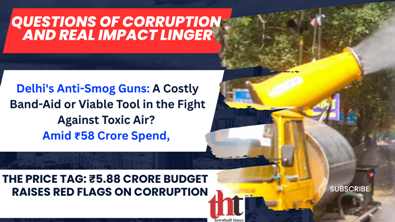
Delhi’s Anti-Smog Guns: A Costly Band-Aid or a Real Weapon Against Toxic Air? Amid ₹58 Crore Spend, Questions of Corruption and Impact Grow
New Delhi, November 17, 2025 – As Delhi’s Air Quality Index (AQI) crosses 450 for the third straight day after Diwali, plunging the city into a suffocating blanket of smog, the government’s reliance on anti-smog guns has sparked renewed controversy. These truck- and building-mounted mist machines, designed to spray fine water droplets that trap dust particles (PM2.5 and PM10), form a key part of the city’s GRAP Stage III response. But with the Public Works Department (PWD) spending nearly ₹58 crore on operations this season, many are questioning whether this is genuine pollution control or a convenient seasonal racket.
Even as experts acknowledge that anti-smog guns offer localized benefits, their city-wide effectiveness remains limited. This has prompted demands for independent audits and full transparency at a time when every breath in Delhi feels heavy and hazardous.
The Supreme Court, in a recent hearing, has asked the pollution authorities to scrutinize the expenditure on such mitigation tools after rising complaints of inflated bills, unexplained tenders, and questionable deployment records. Opposition leaders have seized on the opportunity, calling the spending a “scam in the name of clean air,” alleging inflated contracts awarded to politically connected companies without adequate monitoring.
Rapid Expansion: From 156 to Nearly 356 Guns, But Uncertain Outcomes
Delhi’s anti-smog gun deployment has expanded rapidly this winter, following last year’s alarming spike in “severe” AQI days.
-
Mobile Fleet: Around 200 truck-mounted guns now patrol 11 major zones, covering nearly 1,400 km of roads wider than 60 feet.
-
Fixed Installations: Roughly 140–150 static guns have been mandated on high-rise buildings, with several in central Delhi and dozens on private commercial structures.
-
Total Deployment: About 340–356 anti-smog guns are in daily operation across the city, more than double the fleet from last year.
The Environment Department has defended this expansion, stating that dust accounts for nearly 40 percent of winter pollution. However, activists argue that fewer than half of the mandatory high-rise installations have been fully verified as operational, reflecting a serious enforcement gap.
A Price Tag That Raises Eyebrows
The financial outlay behind the anti-smog operations has triggered intense scrutiny:
-
Daily Cost Per Mobile Gun: Approximately ₹1,470, including truck rental, crew, fuel, and maintenance.
-
Daily City-Wide Cost: ₹5–6 lakh for PWD operations alone; ₹10–12 lakh when water usage and private-sector units are included.
-
Seasonal Outlay: Over a typical October–February period, the expenditure could surpass ₹75–90 crore.
Right to Information (RTI) responses show that contracts for mobile units were awarded to firms with minimal prior experience, at rates reportedly 20–30 percent above the prevailing market. Environmental activists have raised concerns that several units may exist only on paper—so-called “ghost guns”—with inflated billing and weak oversight. Calls for independent audits have grown louder, especially in light of past civic body scandals involving equipment procurement.
Impressive Specs, Limited Lifespan of Impact
Each anti-smog gun is engineered for “wet scavenging,” a method that mimics rain:
-
Water Capacity: 8,000–12,000 liters per day
-
Coverage: 70–100 km for mobile units; 100-meter radius for fixed units
-
AQI Reduction: 10–20 points locally for 2–4 hours
-
City-Wide Impact: Roughly 5–10 percent dust suppression
While these figures demonstrate usefulness at construction zones and dust-heavy corridors, experts warn that the gains are short-lived. In a city with chronic pollution drivers—vehicular emissions, industrial output, and seasonal stubble burning—anti-smog guns offer relief that is visible but superficial.
A pilot study in South Delhi showed a promising 15–18 percent drop in PM10 levels immediately after spraying, and residents in pockets like Maharani Bagh report noticeably clearer air for a few hours. If deployed year-round (except monsoon season), models suggest these guns could shave off 5–7 AQI points city-wide—helpful, but hardly transformative.
Yet, critics caution that the high water usage, spray quality inconsistencies, and limited effects on fine particulate matter (<10 microns) remain serious limitations. Moreover, the absence of real-time GPS monitoring—despite being a mandated requirement—leaves deployments vulnerable to manipulation and inflated reporting.
A Misty Metaphor: Hope, Doubt, and the Need for Accountability
As Delhi intensifies GRAP restrictions—curbing older vehicles, accelerating clean-fuel transitions, and experimenting with cloud-seeding—anti-smog guns serve as a visible gesture of action in a crisis-laden winter. For citizens, even a few hours of cleaner air can feel like a miracle. “At least for a while, the mist lifts the haze,” says Ashok Verma, a resident of Lajpat Nagar.
But for a season’s expenditure crossing ₹58 crore, Delhi’s taxpayers deserve more than misty optics. Transparent tenders, digital tracking, routine audits, and investments in long-term solutions—green buffers, industrial upgrades, and mobility reforms—are essential if the city hopes to breathe freely.
A comprehensive report from pollution authorities is expected in December. Whether it exposes deep-rooted irregularities or validates the deployment strategy remains to be seen. Until then, anti-smog guns continue to symbolize Delhi’s struggle—temporary relief clouded by lingering doubts.
Townhall Times Environment Desk
With analysis from environmental experts and RTI findings.
#DelhiSmog2025 #AntiSmogDebate #CleanAirNow








Leave a Reply