
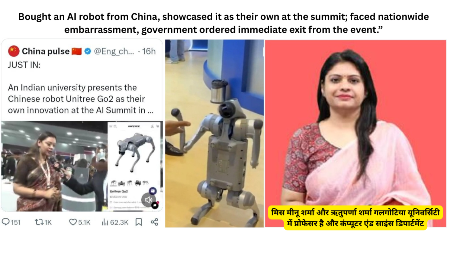
Townhall Times A major question has resurfaced across the nation: What kind of patriotism is it to destroy one’s own talent in the name of caste and religion, only to then glorify Chinese and American technology as one’s own on global platforms? This debate intensified after a massive controversy erupted at the India AI Impact Summit in New Delhi, where Galgotias University showcased a robotic dog named “Orion” as an in-house innovation.
Within hours, social media users exposed that this so-called innovation was in fact the Go2 model manufactured by the Chinese company Unitree, which is commercially available for just two to three lakh rupees. Following the public backlash, government officials immediately instructed the university to vacate its stall, calling the incident a severe blow to India’s credibility in the global AI ecosystem.
The controversy deepened further when it emerged that another product showcased by the university—a drone claimed to be built “from scratch”—was actually the commercially available Striker V3 ARF model. Experts described these actions as damaging to the integrity of Indian academia and a mockery of genuine innovation. This episode has once again highlighted the harsh reality that while India’s own talented students face discrimination based on caste and religion, certain institutions seek to win applause by rebranding imported foreign technology. Over the past seven to eight years, more than forty thousand cases of dropout and suicide among SC, ST, and OBC students have been documented, underscoring the toxic environment prevalent in many educational institutions.
Meanwhile, allegations continue that government-run educational institutions are being weakened deliberately, and disturbing incidents—such as political groups celebrating the cancellation of accreditation of a medical college in Kashmir—reveal how education is being weaponized for ideological purposes rather than national development. When the UGC introduced the UGC Regulation 2026 to curb harassment and create safer campuses, sections of caste-biased media and organisations attempted to stir chaos, opposing reforms meant to protect students. In this environment, the conduct of Galgotias University is seen not merely as a technical misrepresentation but as a betrayal of India’s innovation culture.
If young researchers and scientists are denied opportunities and suffocated under discrimination while foreign products are passed off as Indian achievements, it raises a profound question about the direction in which the nation is heading. The global embarrassment caused by this incident is not just the fault of one university; it is the outcome of a mindset that sidelines domestic talent while finding pride in worshipping imported technology. Unless this mentality is addressed firmly, India’s innovation future risks being lost in the glare of flashy events instead of being built through genuine, homegrown research.









Leave a Reply