
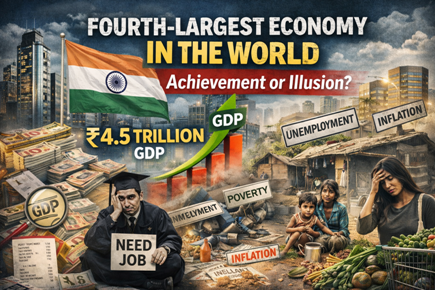
Fourth-Largest Economy in the World: A Grand Illusion or a Real Achievement?
Poverty, unemployment, and inflation continue to rise.
Townhall Times | Special Analysis
India being projected as the world’s fourth-largest economy is being presented as a historic achievement. Estimates suggest that by 2026, India’s Gross Domestic Product (GDP) will reach around $4.5 trillion, surpassing Japan. Yet this milestone is largely confined to macroeconomic indicators. GDP reflects a country’s total production, but it does not reveal the everyday realities of ordinary citizens—employment, inflation, poverty, education, and healthcare. The fundamental question remains: if these basic challenges persist, what kind of development is this?
Unemployment: Jobs Without Security
Start with unemployment. According to official figures, India’s unemployment rate in 2025–26 is estimated to be between 4.2% and 5.2%. But these numbers fail to capture “hidden unemployment” and underemployment. Labour surveys indicate that unemployment among graduate youth has climbed to 13–15%, while in rural areas a large population remains dependent on the informal sector, where stable jobs and social security are virtually absent.
Data from the Centre for Monitoring Indian Economy (CMIE) shows that although total employment has increased since the pandemic, the share of stable, high-income jobs has declined to around 22–24%. In other words, work exists—but it is increasingly insecure, low-paid, and without dignity.
Inflation: Official Calm, Household Pressure
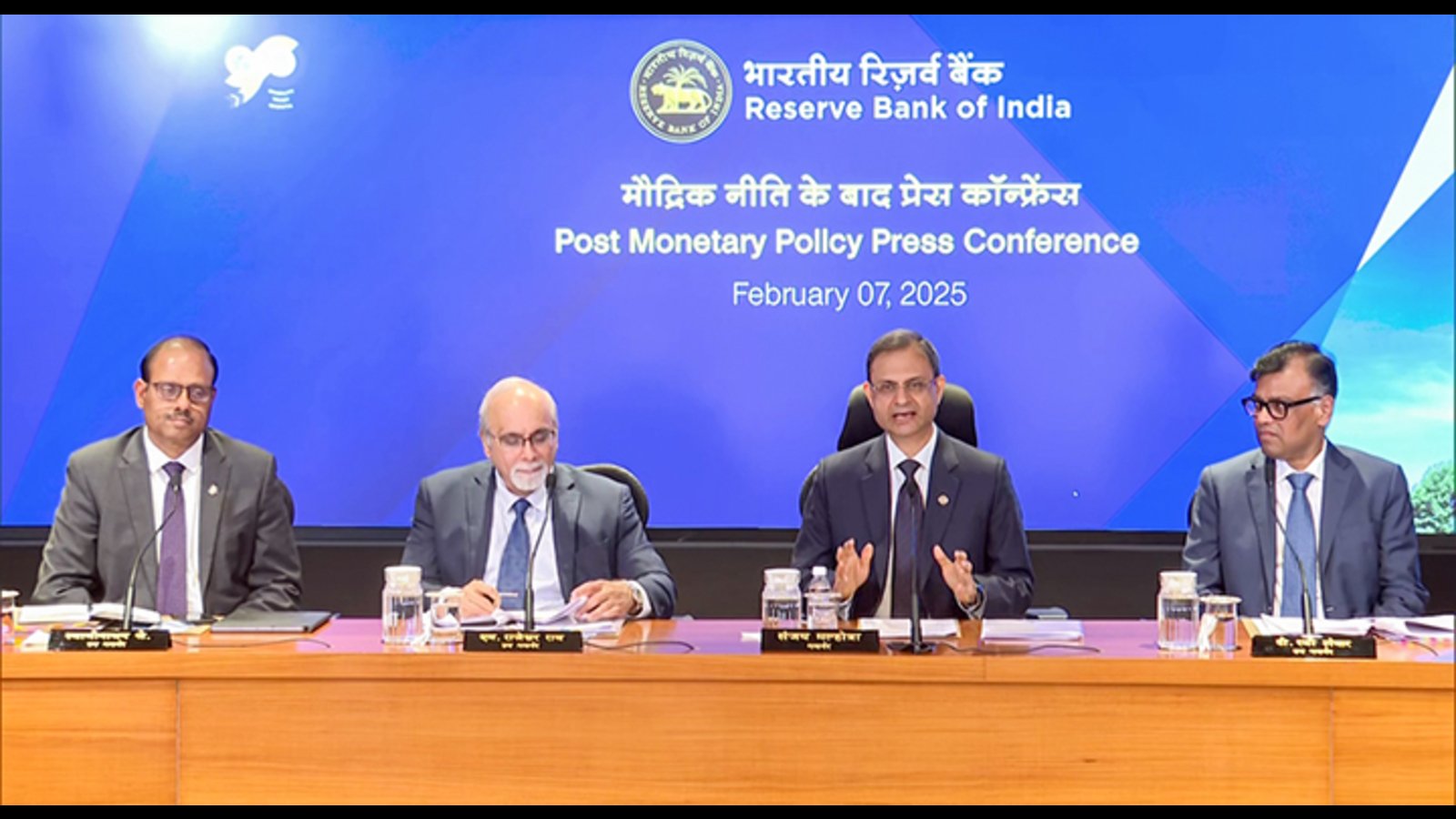
On the inflation front, official statistics appear reassuring. Average retail inflation in 2025 is reported at 0.71%, well below the Reserve Bank of India’s target. However, ground realities tell a different story. Food inflation has remained in the 7–9% range, affecting essentials such as vegetables, pulses, milk, and cooking oil. Fluctuations in fuel and LPG prices continue to strain household budgets, particularly for lower- and middle-income families.
As a result, real income growth has slowed, and domestic consumption—the backbone of India’s economy—is showing signs of stress. Growth in numbers may look impressive, but purchasing power for ordinary families tells another story.
Poverty: Decline on Paper, Deprivation in Life
Poverty statistics present a similarly contradictory picture. According to the World Bank, extreme poverty declined from 16.2% in 2011–12 to 2.3% in 2022–23, lifting nearly 171 million people out of extreme deprivation. Yet NITI Aayog’s Multidimensional Poverty Index reveals that 140–150 million people still lack access to basic necessities such as nutrition, housing, sanitation, and education.
The National Family Health Survey (NFHS) reports that over 35% of children remain malnourished, indicating that despite improvements in income data, deep inequalities in living standards persist. Poverty may be shrinking statistically, but deprivation remains widespread in everyday life.
Education: Underfunded Foundations
Government spending on education is another area of concern. In the 2025–26 Union Budget, ₹1.28 lakh crore was allocated to education—a 6.22% increase from the previous year. Yet this amounts to only 2.5–3.8% of GDP, far below the 6% target set by the National Education Policy. Shortages of teachers in government schools, the digital divide in rural areas, and the lack of basic infrastructure continue to undermine educational quality.
Healthcare: Growth Without Protection
The situation in healthcare is even more alarming. Official data shows that 70% of specialist positions in rural health centres remain vacant. India has only 1.6 hospital beds per 1,000 people, compared to the World Health Organization’s recommended standard of 2 per 1,000. Private healthcare is prohibitively expensive, and despite schemes such as Ayushman Bharat, infrastructure gaps mean that timely treatment still does not reach millions.
India’s rise as the world’s fourth-largest economy is undeniably significant in numerical terms. But when unemployment remains insecure, inflation erodes household budgets, poverty persists in multiple dimensions, and education and healthcare remain underfunded, the celebration appears premature. Economic size alone does not define development. True progress is measured by whether growth translates into jobs with dignity, affordable living, quality education, and accessible healthcare. Until that happens, the claim of becoming a global economic powerhouse risks remaining more illusion than achievement.






Leave a Reply