
Townhall Times, New Delhi
Reporter: Bhavika Kalra
By: Strategic Affairs Bureau | New Delhi Tuesday, February 24, 2026
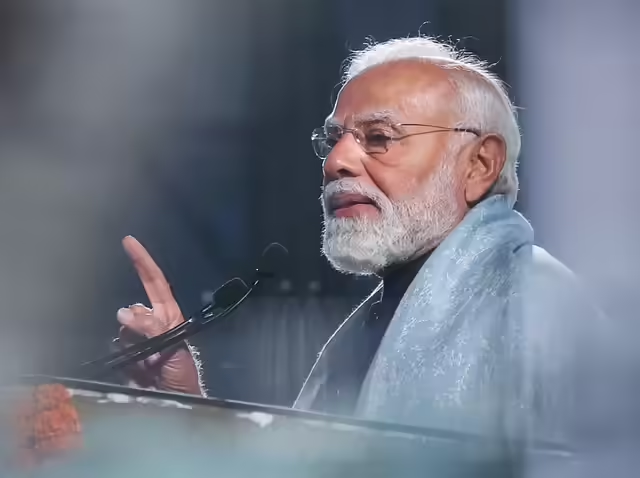
In a world obsessed with “disruptive ideas” and “viral growth,” Prime Minister Narendra Modi did something yesterday that felt both archaic and oddly relevant. He didn’t talk about venture capital or equity Burn rates. Instead, he shared a Sanskrit Subhashitam from the Hitopadesha.
On the surface, it looks like a simple motivational post. But in the context of India’s current tech climate—where we have seen a massive rise in “failed unicorns” and a plateau in real R&D—this message is a tactical intervention. The PM is essentially telling the youth: “The idea is just the first hand. If you want a clap, start working with the second.”
The Anatomy of the Verse
The verse shared by the PM is a classic piece of Vedic-era logic:
“यथैकेन न हस्तेन तालिका सम्प्रपद्यते। तथोद्यमपरित्यक्तं न फलं कर्मण: स्मृतम्।।”
It’s an analogy as old as time: You can’t clap with one hand. In the PM’s 2026 interpretation, “Talent” (Pratibha) is the first hand, and “Hard Work” (Parishram) or “Industriousness” (Udyam) is the second.
Why This Message? Why Now?
India is at a crossroads. We have the world’s third-largest startup ecosystem, but we are also seeing a “hollow innovation” problem. Too many startups are just “copy-paste” versions of Silicon Valley apps.
-
The Talent Trap: We have millions of engineers, but the industry complains about “unemployability.” Why? Because raw talent hasn’t been sharpened by the Parishram of deep learning.
-
The Funding Winter Hangover: After the 2024-25 market correction, the message from the PMO is clear: The era of “easy money” for “just an idea” is over. The government is signaling that it will support those who show the discipline to build long-term, deep-tech solutions (semiconductors, AI, green hydrogen) rather than quick-flip consumer apps.
Tradition as a Tech Strategy
Modi has long used Sanskrit to de-colonize the concept of “modernity.” By linking the Hitopadesha to innovation, he’s making a psychological point: Discipline is an Indian value.
In the current push for Atmanirbhar Bharat, the government is moving away from being a technology consumer to a technology creator. But creation is painful. It requires a level of grit that isn’t found in a pitch deck. By invoking Udyam (perseverance), the PM is preparing the workforce for the high failure rates of the next frontier—Deep-Tech.
The “Execution” Deficit
If you look at the National Education Policy (NEP) reforms being pushed this year, you see this philosophy in action. It’s no longer about just getting a degree (Talent); it’s about the incubation labs, the “maker spaces,” and the grueling process of turning a prototype into a product (Work).
The PM’s message is a direct critique of the “hustle culture” that prioritizes “looking busy” over “being productive.” He is calling for a return to Sustained Excellence. ### The Global Stakes In 2026, global power is measured in patents and semiconductor yields. Both require years of “boring,” disciplined work in a lab. India’s goal to become a global innovation hub by 2030 hinges on whether our youth can move past the “One-Handed Talent” phase.
Conclusion: The Reality Check
Success isn’t an accident. It isn’t a “viral” moment. By bringing Sanskrit back into the conversation, the PM is trying to ground a very high-tech future in a very old reality: There are no shortcuts to greatness.











Leave a Reply