
Townhall Times, New Delhi
Reporter: Bhavika Kalra
By: Regional Investigative Bureau | Jharkhand Tuesday, February 24, 2026
The agricultural silence of Chatra was never meant to be broken like this. At roughly 8:49 PM last night, the sky over Jharkhand’s northern belt turned a violent orange. A silver-and-white fixed-wing air ambulance, which had just cleared the Ranchi skyline carrying a critically ill patient, slammed into an open field at a near-vertical angle.
Seven people were on board. Within seconds of the impact, all seven—the patient, a family member, two pilots, and three emergency medical technicians—were gone. By the time the local villagers reached the site with torches, there was no rescue to be had. There was only the smell of high-octane aviation fuel and the sound of oxygen cylinders venting into the fire.
The Final Minutes: Mapping the Failure
Information trickling out of the Ranchi Air Traffic Control (ATC) paints a chilling picture of the flight’s final moments. The aircraft took off under routine conditions, but as it reached its initial cruising altitude, the radar graph shows a sudden, terminal stutter. The plane’s speed dropped below its critical stall threshold, and the altitude plummeted.
In a small aircraft like this, you don’t have the luxury of time. If you lose an engine or a control surface—the flaps that keep the plane stable—over the rugged, uneven terrain of Chatra, you are essentially flying a brick. Witnesses on the ground described a “choking” sound from the engines before the nose dipped and the aircraft spiraled.
The “Oxygen Torch” Angle
Forensic teams from the DGCA (Directorate General of Civil Aviation) hit the ground at 4:00 AM today. They are focusing on a specific, terrifying technical hazard unique to air ambulances. These planes are packed with high-pressure medical oxygen systems.
If an electrical short-circuit occurred in the cabin—perhaps in the complex ICU-grade cardiac monitors or ventilators—the presence of leaking oxygen would have turned the interior into a pressurized blowtorch. This might explain why the wreckage is so severely charred; the fire wasn’t just fed by fuel, but by concentrated medical gas. The investigators are currently digging through the “blackened” manifold to see if a valve failure preceded the impact.
The Debris: Fragmenting a Tragedy
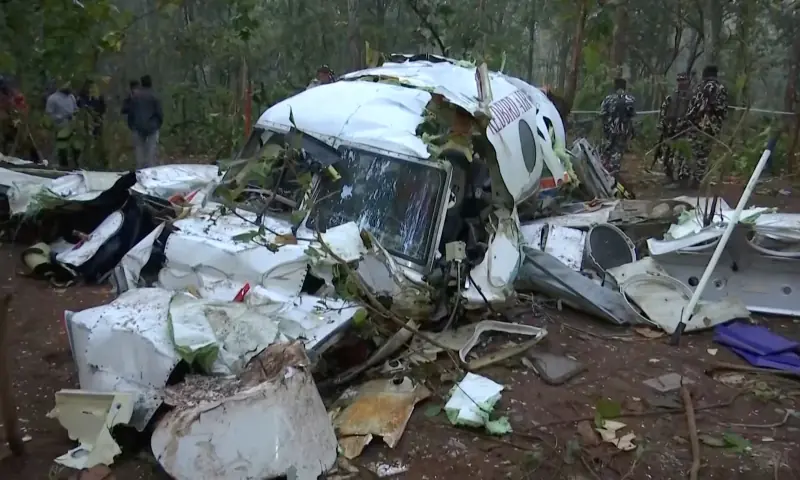
The way a plane breaks apart tells you how it died. At the Chatra site, the engine was found nearly 100 meters away from the tail section. This “high-energy” debris field confirms that the pilots didn’t try to glide or perform a forced belly-landing. The plane hit the ground under full power.
The National Disaster Response Force (NDRF) has spent the morning recovering human remains and personal effects. Among the twisted metal were the remains of portable ventilators and trauma kits—the tools of a trade meant to save the very life that was lost in the dirt.
The Human Toll: Martyrs of the Medevac
While the technicals are for the investigators, the emotional weight is for the city of Ranchi. The three medical staff on board were “Flight Medics”—a specialized breed of healthcare workers who operate in vibrating, cramped cabins, managing life-support systems while hurtling through the air. They died trying to buy a few more hours for a patient who was already in a desperate state.
The patient and their attendant were caught in a cruel paradox: they took to the sky to escape death in a small town, only to find it in a field just a few dozen miles away.
A Systemic “Blind Spot”
This crash isn’t just an accident; it’s a symptom. While India’s commercial airlines are poked and prodded by inspectors, the chartered “Medevac” sector often operates in the shadows.
-
Maintenance Oversight: Do these small operators follow the same rigorous part-replacement schedules as a major airline? Often, the answer is “no.”
-
Pilot Fatigue: Emergency pilots are often on-call 24/7. When the phone rings at 8:00 PM for an urgent transfer, are they sharp enough to handle a mid-air mechanical crisis?
The Search for the Black Box
As the wreckage is hauled away today, the priority is the Flight Data Recorder. In these smaller planes, the “Black Box” is often less protected than in a Boeing 737. The intense heat from the oxygen-fed fire may have damaged the memory chips.
Jharkhand’s administration has promised a “Safety Surge Audit” of all medical flights in the region, but for the seven families currently waiting at the Ranchi mortuary, the policy changes are cold comfort. They want to know why a mission of mercy became a terminal flight.











Leave a Reply