
Townhall Times, New Delhi
Reporter: Bhavika Kalra
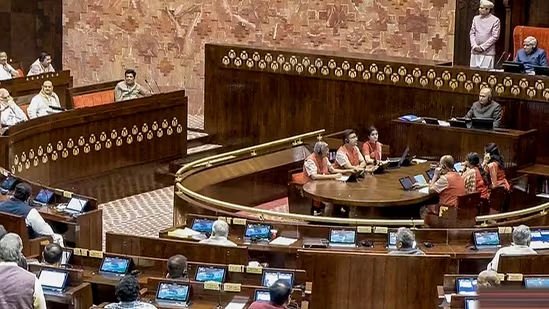
The dust hasn’t settled on the floor of the Lok Sabha yet, but the battle lines for 2026 have been drawn in permanent ink. Today, Monday, February 23, 2026, as the Parliament reassembles, the air in the new Kartavya Bhawan isn’t filled with the usual polite debate. It’s thick with the kind of high-stakes political theater that only happens when a government tries to balance a “growth-first” agenda against a restless, job-hungry population.
Finance Minister Nirmala Sitharaman, now into her ninth consecutive budget, presented a vision on February 1st that she called a “Yuva Shakti” budget. But if you listen to the shouting matches in the Rajya Sabha today, the Opposition—led by a particularly vocal Rahul Gandhi and TMC’s Abhishek Banerjee—isn’t buying the “Viksit Bharat” dream. They’re calling it a “loud in slogans, soft in solutions” document.
The Inflation Trap: Why Your Kitchen Budget is a Political Weapon
The most heated moments today centered on the “thali.” The Opposition didn’t just bring up data; they brought up stories of families in rural Uttar Pradesh and urban Mumbai who are watching their savings evaporate.
While the Finance Ministry pointed to a “manageable” inflation rate of around 4% to 5%, the ground reality is a different beast. Food inflation, specifically in pulses and edible oils, has been stubbornly high. The government’s defense is consistent: “Global supply chains are broken, and we are doing better than the West.” But that’s a tough sell when an LPG cylinder still eats a massive chunk of a minimum-wage worker’s monthly earnings.
The debate today took a sharp turn when the Opposition accused the government of using “crony-focused” fuel pricing while the common man pays the “stability tax.” The government’s retort? Targeted subsidies like Ujjwala 2.0 are the only reason the poor haven’t been crushed entirely.
The Job Crisis: Startup Dreams vs. Ground Realities
If there’s one thing that could actually derail the “Triple Engine” government’s momentum, it’s the youth. The budget has bet big on the Textile Expansion and Employment Scheme and a new SME Growth Fund worth ₹10,000 crore. The idea is to turn India into a manufacturing hub that rivals China.
But the Opposition’s attack today was surgical. They pointed to the “missing middle”—the millions of graduates who aren’t tech founders or “Champion SMEs” but are just looking for stable, entry-level work. Rahul Gandhi’s speech today, which was interrupted three times by ruckus from the Treasury benches, focused on the New Income Tax Act, 2025 (set to go live in April 2026). He argued that while the forms are getting “simplified,” the job market is getting “evaporated.”
The government, meanwhile, is doubling down on Infrastructure as an Employer. With a massive ₹11 lakh crore set aside for capital expenditure, they’re basically saying: “We will build the roads, and the jobs will follow.” It’s a long-term play, but in politics, people vote on their short-term bank balance.
The Federalism Fire: “Politicizing the Purse Strings”
Things got genuinely nasty when the discussion turned to tax devolution. Leaders from the Secular Progressive Alliance (DMK) and TMC staged a brief walkout today, claiming their states are being “starved” of funds while “Purvodaya” states (like Bihar and Odisha) get five new tourism destinations and 4,000 electric buses.
The 16th Finance Commission’s recommendations are being used as a shield by the Centre, but the Southern states are screaming about the “GST compensation gap.” It’s a classic Centre-State brawl, but with the 2026-27 fiscal year being a precursor to major state elections, every rupee diverted to a bridge in Surat is being treated as a personal insult by a lawmaker in Chennai.
The “Epstein” Distraction and JNU Tensions
It wouldn’t be an Indian Parliament session without a few wildcards. Congress MP Manickam Tagore actually submitted an Adjournment Motion today to discuss references to Indian names in the “Epstein Files”—a move the Speaker quickly shut down as “irrelevant to the budget.”
Outside the house, the tension is just as high. Digvijaya Singh made headlines today by demanding that the VC of JNU withdraw the rustication of student leaders. He’s arguing that the university’s budget is being slashed to silence dissent. It’s a side-show to the main budget, but it fuels the narrative that the government is more interested in “control” than “growth.”
The Final Word: A Gambler’s Budget?
As the house adjourned for the evening, the consensus among analysts is that this budget is a massive gamble on Capital Expenditure. Nirmala Sitharaman is betting that if she keeps building railways and ports, the private sector will eventually stop “sitting on its cash” and start hiring.
But with the debt-to-GDP ratio sitting at 55.6%, the room for error is zero. If the global economy wobbles or if the monsoon fails this year, the “Viksit Bharat” roadmap might hit a very expensive dead end.




Leave a Reply