
Townhall Times, New Delhi
Reporter: Bhavika Kalra
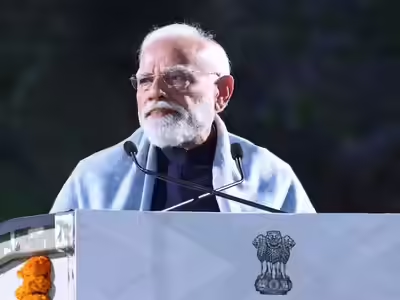
Forget the usual tech buzzwords for a second. Today, February 18, 2026, the atmosphere in New Delhi wasn’t just about another “summit”—it was about a full-scale national pivot. At the India AI Impact Summit, PM Modi laid out a plan that sounds like science fiction: taking India from a service-hub to a global AI leader by 2047.
But behind the glitzy presentations, there are some very real, very massive moves happening.
1. The “Compute” War: Building India’s Own Brain
The biggest bottleneck for any AI startup in India has always been the cost of cloud computing. We’ve been paying billions to US-based tech giants just to rent their processing power.
-
The Fix: The government just greenlit the National AI Compute Grid. Think of it as a massive, public-sector supercomputer that Indian startups can use for cheap. It’s about “Digital Sovereignty”—not having to ask a foreign company for permission to train an Indian AI.
-
The Fund: A multi-billion-dollar India AI Innovation Fund was announced to back home-grown companies that are solving “desi” problems, like predicting monsoon patterns or automating vernacular translations.
2. “AI for the Village, Not Just the Valley”
The PM’s speech hit a specific chord: “AI for All.” He argued that if AI only helps people in Bengaluru or Delhi, it has failed.
-
Agriculture: We’re looking at AI tools that can scan a leaf via a ₹10,000 smartphone and tell a farmer exactly which pest is eating his crop and which local pesticide to buy.
-
Healthcare: The plan is to use AI for “Radiology at Scale.” Imagine a health center in a remote village in Odisha where an AI instantly scans an X-ray for TB or cancer because there’s no specialist for 200 miles.
3. The Jobs Question: Opportunity or Bloodbath?
This was the elephant in the room. Does AI mean millions of Indians lose their jobs?
-
The Reality Check: The summit didn’t shy away from the fact that “routine” data entry or basic customer service jobs are in the line of fire.
-
The Pivot: The government is betting on a massive re-skilling campaign. The goal is to churn out “AI Ethics Auditors” and “Data Scientists” from Tier-2 and Tier-3 cities. It’s a race to see if we can train people faster than the bots can replace them.
4. Language: Breaking the “English-Only” AI
Right now, most AI (like ChatGPT) is heavily biased toward English.
-
The “Indic” Push: A major theme today was the development of Indic Language LLMs (Large Language Models). We’re talking about AI that understands the nuances of Bhojpuri, Tamil, or Marathi perfectly. This is how you bring the “Next Billion” users online.
5. The Ethics Shield
With all this data flying around, privacy is the big worry. The summit introduced a framework for “Anonymized Public Data Access.” The idea is to let researchers use government data (like health records or traffic patterns) to build better tools, but without exposing anyone’s name or identity. It’s a tightrope walk between innovation and “Big Brother” surveillance.
The 2047 Target: What’s at Stake?
By the time India hits its 100th year of independence, the goal is to be in the Top 3 AI Superpowers.
-
Current Status: We have the talent, but we lack the hardware (chips/GPUs).
-
The Strategy: Use our massive scale. India has more data than almost any other country on earth. If we can organize that data safely, we don’t just use AI; we build the AI the rest of the world uses.
The Verdict: This isn’t just about a “tech upgrade.” It’s about whether India can stop being a “user” of global tech and start being the “architect.”










Leave a Reply